Thursday, July 31, 2008

Google Knol - the unit of knowledge

Google Knol was officially launched is out of its beta state. Knol - the word means a unit of knowledge. Google defines Knol as an authoritative article about a specific topic. All articles written in knol is verified by authorities in the topic before publishing. This makes Knol a trustable unit of Knowledge.

Knol is widely regarded as Google's attempt to beat Wikipedia. I am a huge fan of Wikipedia. But the fact that anyone can edit the contents of Wikipedia reduces its accuracy. It is said that there is a 1% factual error in every major article written in Wikipedia. This chance of error increases with less important topics. This is where Knol comes in use. Even though anyone can write a Knol, it is not published until it is verified by an authority in the topic.

There are a few hundreds of topics presently there at Knol. But being a Google product, it is very likely that it will keep increasing exponentially in future. None of the Google products had been a failure. Even though Google ads will be present in Knol, Google says that it will be minimum and content will be given sole importance.

Google Knol
You can Join Knol here or you can just Login with your Google account like any other Google services

Tuesday, July 29, 2008

What is Overclocking?


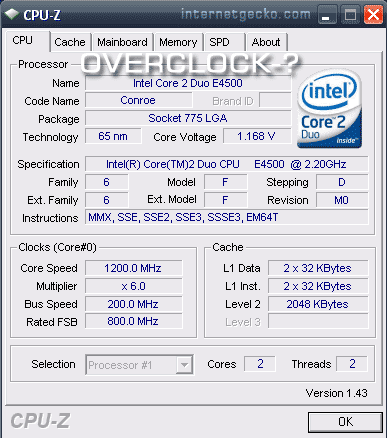
The process of forcing any computer component like, processors, RAM, video cards and motherboard chipsets to run in a higher clock speed than the speed to which it was designed for by the manufacturer is called Overclocking. Overclocking is generally done by home PC users to boost the performance of their computer.

The main objective of overclocking is to improve the performance of low clock speed components to meet the minimum requirement of some new hardware or software. Some also overclock components to attain better performance from it. OEM systems generally disable this feature to prevent misconfiguration.

Even though it seems simple, overclocking is actually a very complex process involving high risk. One has to ensure sufficient voltage is given to the overclocked component. Excessive power can prove destructive too. Sufficient cooling measures should be taken as overclocking results in production of increased heat by the component.

News on overclocking

Thursday, July 24, 2008

What is VoIP or BroadBand phone?

VoIP or Voice over Internet protocol is a protocol that transmits voice over any packet swicthed network like Internet. The term VoIP is more generally used for actual transmission of voice through internet like broadband telephony, IP telephony, broadband phone or Internet Telephony. It actually refers to digital transmission of voice through Internet.

VoIP transmission can be done from pc to pc, pc to phone or phone to phone. It is largely dependents on the service provider who provides this broadband phone facility. To become the customer of IP phone, you need a computer with a broadband connection or a special type of phone with VoIP adapter.

The major advantage of VoIP is that calling rates for long distance calls are considerably reduced. VoIP calls are also generally more secure than traditional phone calls since the data is encrypted and transffered over network which is not easy to be tapped.

Wednesday, July 23, 2008

What does the project fork term mean in open source terminology ?

When the source code of one open source software is copied entirely to modify and make a new one, it is called a fork. Usually forks are produced as a result of efforts to produce a new product with different point of view (goal) than the original product.

Forks are most common in Linux distributions. The most common example of fork is the Ubuntu project. It is a famous freely shipped Linux distro. But many of the non-techies dont know that it was forked from the first major Linux distribution in the world, Debian. Many of us even don't know that such a distribution exists. While in this case forking is friendly, many cases it can result in a war between forked and the original product.

Forking is one of the major drawbacks of the open source license. One can simply copy and change its name to make an entirely new product and can distribute. Such a situation is harmful for the software community since it duplicates the efforts put to develop the software and creates confusion among users to choose the product.

Fear of forking essay

Sunday, July 20, 2008

What is MD5 Encryption?

MD5 or message digest 5 is an encryption algorithm widely used for password comparisons. Basically MD5 is a hashing algorithm which takes a message of any length as input and produces a 128 bit or 32 hexadecimal digit digest as output. Even a very small variation in the inout string like one character can produce significant change in the output MD5 encrypted hash.

MD5 is a one way algorithm. That means a reverse algorithm of MD5 cannot decode the message digest back to its original message.

MD5 was designed in 1991 by Ron Rivest.


Saturday, July 19, 2008

JPEG image compression technique


I just completed reading the official FAQ of JPEG from faqs.org. JPEG is actually 'lossy' image standard widely used for compression of images. It stands for Joint Picture Experts Group which is the team who wrote this standard image file format from IETF.JPEG is mostly compared to GIF which has its own advantages and disadvantages over jpg.
The major problem associated introduction of with JPG was that the original group who worked behind the JPG format could not lay down a "standard" format due to certain internal limitations. Therefore major vendors manipulated the technologies behind the compression system to their own will even though basics remained the same.

JPEG uses the limitations of human eye such as inability to differentiate hue changes than changes in brightness. So a JPEG image scanned using a machine or software is likely to find errors but when viewed through human eye, it is almost unable to distinguish between the original image and compressed image. This make JPEG a lossy standard. But this small loss is compensated by the compression ratio. A JPG image is compressed to a ratio of 1:20 without visible changes in quality. If ready to give up a little details, one can compress this to 1:50 or even more. This makes JPG the favorite standard of web masters. Because during transmission over a network priority is transmission time rather than image quality. Since compression ratio is more, a JPG can be transmitted over internet with greater speed.
Unlike GIF, which holds 8bit data per pixel, JPEG holds 24bit. So that converting a true 24 bit data into a web standard image format is more viable with JPG. Experts say that GIF is very likely to be extinct in near future.

JPG compresses cartoon or black and white images poorly compared to GIF which is a limitation of JPG. Another problem arises when the sharp edges occurs. Dithering can take place at sharp edges in a jpg image.

JPG losses more data with repeated compression and decompression. So one should never try to compress a file that was once compressed.

There are two types of JPG mainly. They are baseline and progressive. In baseline all the image is read at once by the decoder. This make the image visible at once. But in a progressive one each image is split into various sections and are scanned differently. So for a viewer, it would seem that a progressive scanning results in faster loading but actually the time taken to completely view the file is same.

A JPEG file can not be made transparent at specific locations in a file unlike GIF. This is because of the fact that JPG is a lossy format.


IPv6- Internet protocol version 6


IPv6
is an advanced implementation of internet protocol to include more space and thus more flexibility in assigning an IP address. Before learning about IPV6 I had doubted how how can one assign unique IP to each internet user in the cyberspace when the internet usage is going to explode in the years to come. And that was the same reason I Googled IPV6. And I'm sure my doubts are cleared now. It will be same for you if you know the number of combination of IP addresses possible with the next generation version of internet protocol name IPV6.


The exhaustion of IPv4 was predicted in 1992 and the call for a next generation internet protocol was initiated by IETF(Internet Engineering Task Force) in 1994. It was called IPng or Internet protocol next generation.

IPv6 supports 2^128 address since it uses a 128 bit code. In IPv4 it was 32 bit. An IP address in IPv6 is written in 8 groups containing 4 hexadecimal digits each.If any of the group if complete zeros it may be omited and can be replaced by '::'. Leading zeros can also be omitted as in IPv4.Thus a sample of v6 IP will be

2001:0db8:0000:0000:0000:0000:1428:57ab

In URLs version 6 IP should be enclosed in square brackets as in
https://[2001:db8::1428:57ab]:443/


Features of IPv6

  1. The major improvement of Ipv6 over its predecessor was the larger address space possible.It completely avoids any kind of exhaustion of IPs and requirement for subnetting of the IP address.But this comes with a cost. That is this creates a bandwidth overhead.
  2. IPv6 also supports a stateless address auto configuration. This means that whenever an IPv6 host is connected to a routed IPv6 network the IP address will get configured automatically. It also supports statefull address configuration as in IPv4 via DHCPv6.
  3. IPv6 supports a static link-local address apart from the global address that applications generally use.
  4. IPv6 can send and receive packets over the limits of up to 4GB while IPv4 had support only for 64KB.
  5. Forwarding is made faster in Internet protocol version 6 by avoiding the checksum field implemented in IPv4. In IPv6, the link layer and transport protocols does the error checking thereby transportation speed is improved.


Primarily there are three types of IPv6.
namely,
  • Unicast Addresses
  • Multicast Addresses
  • Anycast Addresses

A Unicast address identifies a single network interface. Multicast identifies more than one. In a multicast address a packet sent to it is delivered to all interfaces Identified by it.Anycast addresses are assigned to different nodes for more than one interface.